
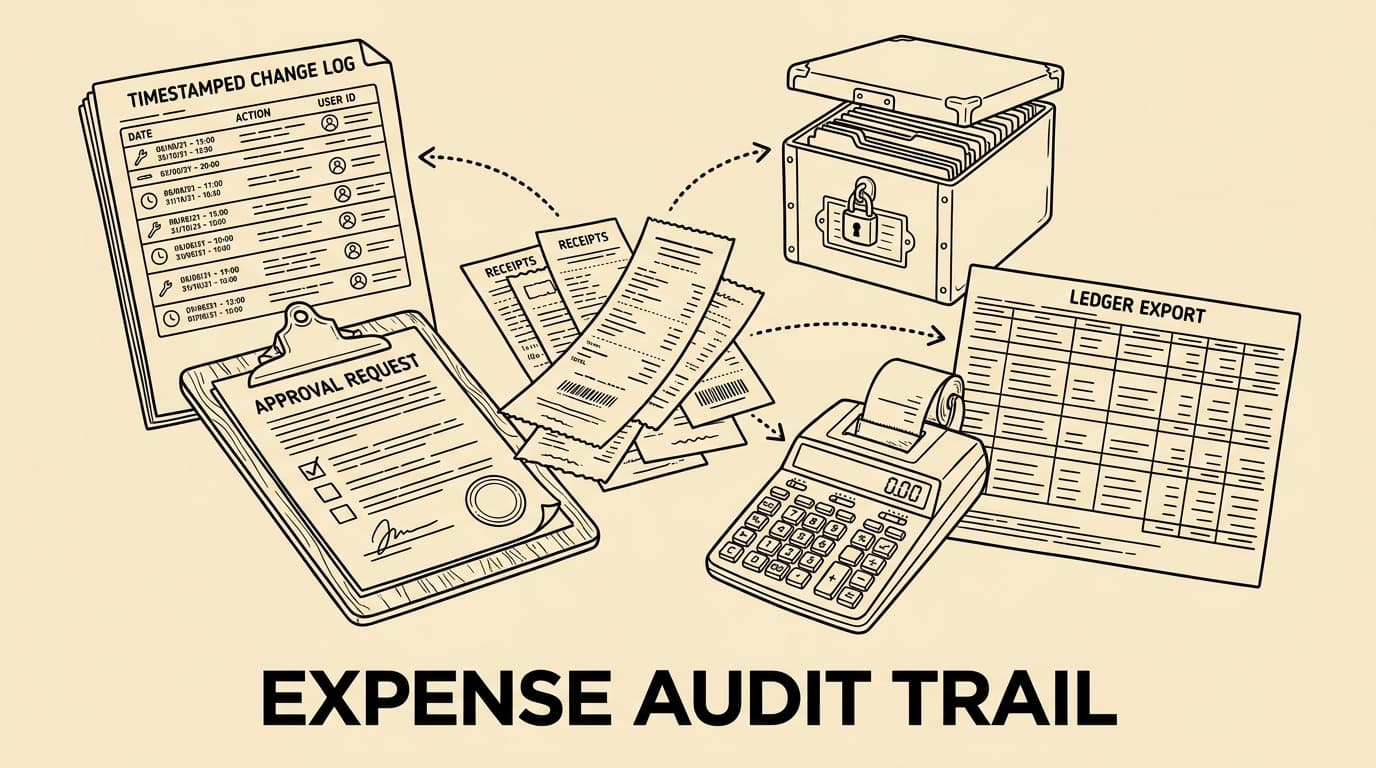
An audit trail in expense management is the practical record of who submitted a cost, which receipt supported it, who approved it, what changed, when it changed and where the data went next. For a finance team, that trail is not only useful during a tax review. It is also the fastest way to answer everyday questions from managers, accountants and employees without searching through email threads, chat screenshots or spreadsheet versions.
The goal is not to turn expense reporting into bureaucracy. The goal is to make the normal process leave reliable evidence behind. When receipts, policy decisions, approvals, reimbursements and accounting exports are linked, the team can prove the story of every expense with less effort. That matters for small businesses, remote teams and growing companies that need professional controls but cannot afford a slow month-end close.
What an expense audit trail must show
A useful trail starts before approval. Each claim should connect the employee, date, merchant, amount, currency, category, project or cost centre and the original receipt image. If a receipt is corrected, split across categories or matched to a corporate-card transaction, the system should keep the earlier state and record the reason for the change. This gives reviewers context instead of a static number.
The same principle applies to approvals. A manager’s decision should be linked to the version they reviewed, not to a later edited version. If policy allows an exception, the exception should have a short note and a visible approver. That combination makes a future review faster because the question becomes whether the policy was applied consistently, not whether the team can find the missing email.
Why spreadsheet-based trails break down
Spreadsheets can record expenses, but they rarely preserve reliable sequence. Rows can be overwritten, filters hide context and attachments usually live somewhere else. Once an exported file is emailed to an accountant, another copy appears. The finance team then has several versions that look authoritative but do not explain which one is final.
That weakness becomes visible at month end. A manager asks why a hotel cost was reimbursed, an employee says the receipt was uploaded, and accounting has a different category in the ledger. Without a trail, the team has to interview people. With a trail, finance can open the record, view the receipt, approval, edits and export timestamp, and decide whether a correction is needed.
The evidence chain from receipt to ledger
Spreadsheets can record totals, but they do not preserve sequence, attachments and responsibility reliably. Filters, copied files and overwrites make later reconstruction fragile, especially when several managers approve costs in parallel.
A workflow-based trail turns those same steps into structured events. Finance can see submission, receipt status, policy result, approval, correction and export in one place, which reduces manual investigation.
- Keep one stable identifier for each expense.
- Store the original receipt with controlled access.
- Record approval, exception reason and export reference.
- Review missing evidence before reimbursement or close.
Approval history and policy exceptions
The evidence chain should connect source document, claim, approval and ledger export with one identifier. Stable links matter more than pretty reports because reviewers need to follow the cost backwards without asking the employee again.
When the chain is intact, accountants can verify VAT fields, categories and cost centres faster. The trail supports professional judgement; it does not replace it.
Change logs, corrections and reversals
Corrections are normal. A mature process records original value, new value, editor, timestamp and reason, then shows whether the change happened before or after approval and export.
This is especially useful for refunds, split expenses and duplicate claims. The correcting entry should point back to the original so the same issue is not rediscovered later.
Retention, privacy and access control
Retention should be deliberate. Finance should define which documents are accounting records, how long they are kept, who may view them and when they are archived or deleted.
Because receipts can contain personal data, GDPR principles such as data minimisation, storage limitation and appropriate security should shape the access model.
Month-end review workflow
At month end, use the trail as a review queue. Filter missing receipts, policy exceptions, late submissions, unmatched card transactions and edits after approval.
Patterns are more valuable than isolated blame. Repeated exceptions can reveal unclear policy, bad categories or a need for better employee reminders.
How to implement the trail in stages
Start with minimum fields and mandatory receipt capture. Then move approvals into the same workflow, connect accounting exports and add exception reporting.
A staged rollout is easier for employees and safer for finance. The trail becomes part of daily work rather than a separate compliance project.
- Keep one stable identifier for each expense.
- Store the original receipt with controlled access.
- Record approval, exception reason and export reference.
- Review missing evidence before reimbursement or close.
Practical checklist for finance teams
The practical checklist is one identifier per expense, original document, immutable timestamps, approver, exception reason, edit history, export reference, retention rule and restricted access.
Review the checklist after the first close. If a field is often wrong or skipped, improve the process before the habit becomes permanent.
- Keep one stable identifier for each expense.
- Store the original receipt with controlled access.
- Record approval, exception reason and export reference.
- Review missing evidence before reimbursement or close.
Common mistakes to avoid
Avoid treating the audit trail as an end-of-month report. Context disappears quickly when decisions happen in email and documents are stored in different places.
Also avoid collecting unnecessary personal information. Strong evidence and privacy-conscious design can support each other when the workflow is clear.
FAQ
Is an audit trail the same as an audit report?
No. The trail is the underlying history of events and evidence. A report is a summary created from that history.
Should every receipt be kept forever?
No. Retention should follow applicable accounting and tax rules, balanced with privacy principles and internal policy.
Can small teams use an audit trail without heavy software?
Yes. Start with consistent fields, receipt capture, approvals and export references. Automation becomes more valuable as volume grows.
What is the first process to fix?
Fix missing receipts and unclear approvals first. They are the most common source of avoidable review work.
Bill.Dock helps finance teams capture receipts, approvals and export-ready histories in one workflow, so the audit trail is created while people work rather than reconstructed later.
A reliable audit trail is not a luxury control. It is the operating memory of the expense process: the proof, context and sequence that keep finance fast, fair and ready for review.
Governance without slowing people down
The best audit trail is almost invisible to the employee. A mobile upload, a clear category choice and a simple manager decision can create enough structure for finance without asking every traveller to understand accounting rules. The control burden stays with the workflow, not with memory.
Signals finance should review weekly
A short weekly review catches weak evidence before month end. Finance can look for missing receipts, unusually late submissions, repeated category changes, card transactions without matching claims and exceptions approved by the same manager several times. These are signals for process improvement, not automatic accusations.
How accountants use the trail
Accountants need a clean path from transaction to document. When the export includes category, tax fields, cost centre and a stable receipt link, they can resolve questions quickly and leave fewer comments for finance. That is especially useful when closing deadlines are tight.
Training and policy feedback
The trail also shows where policy language is unclear. If many employees choose the wrong meal category or forget hotel folios, the answer may be a better form, clearer examples or an automated reminder rather than another long policy document.
Card and cash edge cases
Corporate cards, petty cash and reimbursable employee spend often meet in the same close. A practical trail should show whether the expense was paid personally, by company card or from a cash box, because the evidence needed for reimbursement, matching and reconciliation is different in each case.
Escalation rules
Not every exception needs a long discussion. Define which items can be accepted with a short note, which require finance review and which must be rejected before reimbursement. Clear escalation rules make the trail more consistent and reduce pressure on individual managers.
Evidence completeness sample
Finance should periodically open approved expenses and ask whether an independent reviewer can understand the business purpose, receipt, approval and export without extra explanation.
Reviewer handover note
When the answer is unclear, add a handover note that explains which field, attachment rule or exception reason will be improved before the next close.
Close readiness owner
Assign one owner to confirm that accepted gaps are temporary and that the improvement backlog is reviewed before the next reporting cycle.
Audit trail ownership model
A simple ownership model keeps the audit trail reliable after launch. Employees own timely receipt capture, managers own policy decisions, finance owns review quality, and accounting owns export reconciliation. When those roles are explicit, gaps are easier to resolve and the process remains useful beyond the first publication month.