
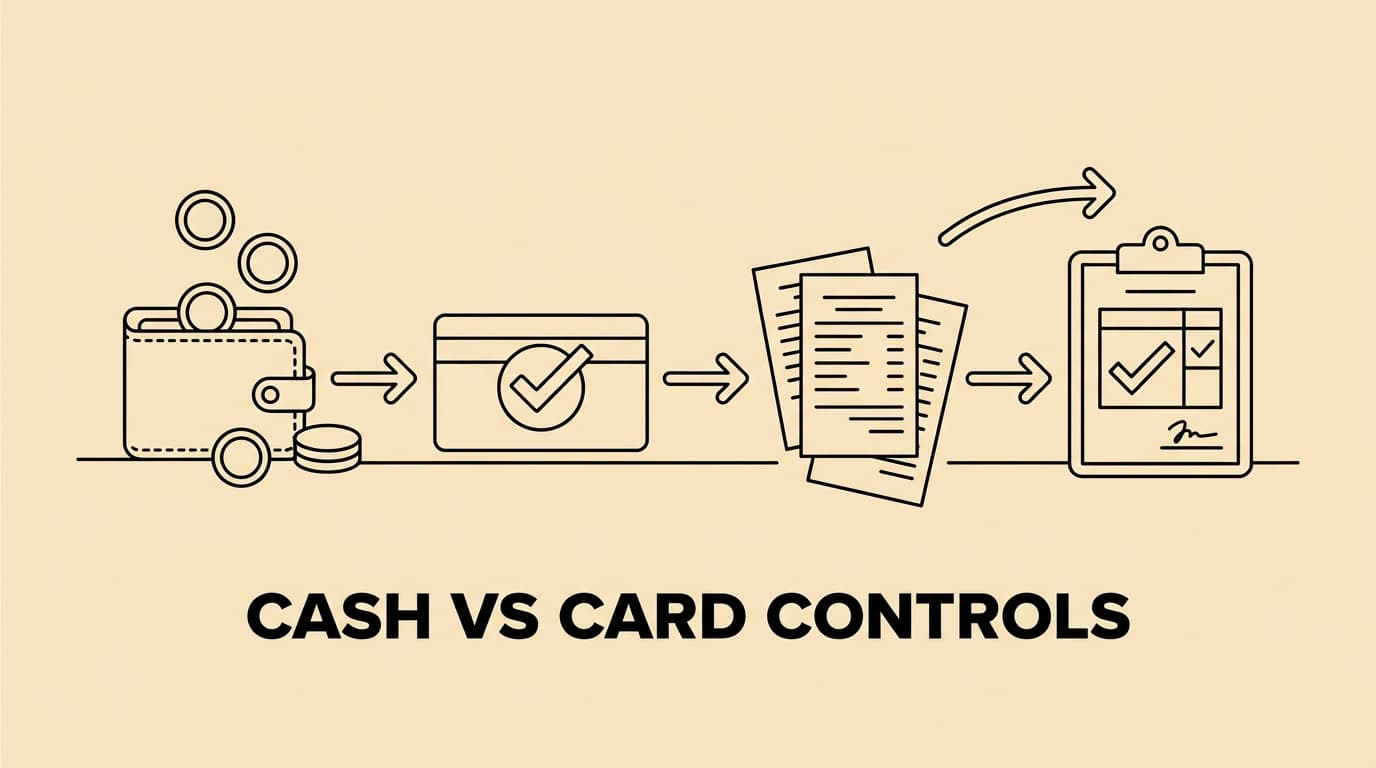
Cash Vs Card Expense Controls is a payment-method control problem as much as an accounting problem.
When the payment method becomes the control point
Every expense policy eventually reaches the same practical question: should this purchase be paid in cash, by a personal card, or through a controlled company card? The answer is not only about convenience. It determines the evidence finance receives, the approval trail managers can review, and the speed with which month-end close can separate ordinary spending from exceptions.
Cash can still be useful for very small, local, or urgent purchases. Cards are usually stronger when the business needs merchant data, spending limits, and a digital record that can be matched to a receipt. A modern policy does not ban one method blindly. It defines where each method belongs, what evidence is required, and which exceptions must be reviewed before reimbursement or bookkeeping.
Why cash is difficult to control
Cash is flexible, but it is also the payment method with the weakest automatic trail. Finance normally learns about the expense only after the employee submits a receipt or a petty-cash voucher. If the receipt is missing, faded, split across several purchases, or submitted late, the approver must reconstruct the business purpose from memory.
That does not make every cash expense suspicious. It means cash requires a tighter manual process: numbered vouchers, a clear business reason, a custody log for petty cash, and a rule that undocumented cash spend is treated as an exception rather than as a normal reimbursement item.
Where card spending improves visibility
Card payments create a separate data trail before the receipt is even attached. The transaction date, merchant, currency, amount and cardholder are usually visible to the finance team. That makes it easier to spot duplicate submissions, personal merchants, out-of-policy categories and transactions that were never documented with a valid receipt.
The card record is not a replacement for tax evidence. For VAT or sales-tax recovery, businesses still need invoices or receipts that contain the required information in the relevant country. The card record is the control signal; the receipt remains the documentary proof.
A simple decision matrix
Use cash only when the purchase is low value, local, and impossible or impractical to pay by card. Examples include small parking fees, market purchases, or emergency local services where a card terminal is unavailable. Require immediate receipt capture and a short explanation.
Use cards for recurring travel, software, fuel, hotels, team meals and supplier purchases where merchant data matters. Require a receipt, business purpose, category, cost centre and timely approval. Use bank transfer or invoice workflow for larger supplier commitments where purchase approval should happen before money leaves the business.
Policy rules that work in practice
A good policy is specific enough to enforce and short enough that employees actually read it. Define which spend types may use cash, which must use a card, which require pre-approval, and which are never reimbursable. Avoid vague language such as “reasonable expenses” without examples; it creates inconsistent approvals.
The policy should also say what happens when evidence is incomplete. For example: the expense can be held for clarification, approved only with manager sign-off, coded as non-deductible, or reimbursed without VAT recovery. This turns missing documentation into a visible control event rather than a quiet bookkeeping compromise.
Receipt requirements and tax evidence
In EU contexts, VAT-registered businesses rely on invoices or receipts that satisfy basic invoicing rules before input VAT can normally be deducted. The European Commission explains that VAT invoicing follows EU-wide rules with national details, and that electronic invoices can be equivalent to paper invoices when conditions are met.
For German businesses, GoBD principles emphasise traceability, completeness and tamper-resistant retention of accounting records. Similar record-keeping expectations exist in other markets. The operational lesson is consistent: the payment method does not prove the expense by itself. Finance needs a readable document, a business purpose and a retention path.
Approval workflow for card expenses
Card controls should start before the transaction. Assign spending limits by role, project or card type. Block categories that the company never reimburses. Require pre-approval for travel bookings, unusually high purchases, and new suppliers. Then use post-transaction approval to confirm business purpose and documentation.
The best workflow is not the longest workflow. A low-risk train ticket should not need the same path as a director’s conference trip. Build thresholds: auto-route ordinary low-risk items to a direct manager, send exceptions to finance, and escalate policy breaches only when the evidence suggests real risk.
Approval workflow for cash expenses
Cash expenses need fewer automation options, so the process must be disciplined. Require same-day capture where possible, a numbered voucher for petty cash, and a short reason why card payment was not used. For recurring cash purchases, ask whether the supplier should be moved to invoice or card payment instead.
Petty cash should have one owner, one reconciliation rhythm, and one documented cash box balance. Every top-up should connect to approved vouchers. Without that custody chain, the finance team cannot distinguish ordinary small purchases from undocumented leakage.
Exception queues finance should review
The exception queue is where the control system proves its value. Review missing receipts, duplicate amounts, weekend or holiday transactions, split purchases just below a limit, personal-looking merchants, cash claims after a card was available, and card transactions that remain uncategorised near month-end.
Do not treat every exception as misconduct. Many are training issues: a traveller forgot to photograph a receipt, a supplier used a confusing merchant name, or a restaurant receipt lacked attendee notes. The point is to make the problem visible early enough to fix it.
How Bill.Dock supports the control model
Tools like Bill.Dock can help finance teams capture receipts quickly, attach them to the right transaction, and keep the review trail in one place. That is especially useful when the business uses both card and cash: the team can apply one evidence standard even when payment methods differ.
The practical win is not automation for its own sake. It is a cleaner handover from employee to manager to accounting: fewer missing documents, clearer categories, and a more reliable audit trail for month-end close and tax preparation.
Implementation plan for the next thirty days
Start by exporting the last two months of expense data and tagging each item as cash, personal card, company card, invoice or bank transfer. Identify categories where cash is still common. Then decide whether cash is genuinely needed or simply a habit left over from an older process.
Next, rewrite the policy in payment-method language: “Use card for travel and online purchases”, “Use cash only when card is not accepted”, “Attach receipt before reimbursement”, and “Explain the business purpose in one sentence”. Finally, create a weekly exception review until behaviour stabilises.
Ownership model for mixed payment methods
Assign clear ownership for each payment route. Procurement or office management can own preferred suppliers, HR can communicate reimbursement rules, managers can confirm business purpose, and finance can own tax evidence and exception review. Without that split, every unusual transaction becomes a debate about who should decide. With it, employees know where to go before they spend, and approvers know which part of the control they are responsible for.
Data fields to capture every time
A consistent expense record should contain payment method, amount, currency, merchant, date, category, cost centre, business purpose, receipt image, approver and exception reason where relevant. These fields are simple, but together they create the audit trail. They also help finance compare cash and card behaviour without relying on anecdotes. If one field is often missing, the workflow or training needs adjustment.
When to convert cash habits into card rules
A repeated cash claim is a process signal. If the same team, location or supplier appears again and again, finance should ask whether a card, invoice or approved supplier route would be safer. The goal is not to punish a practical workaround. The goal is to convert a workaround into a documented method before it becomes normal leakage.
FAQ
Should a company ban cash expenses completely? Not necessarily. A strict ban can create friction in markets or situations where card payment is unavailable. A better rule is to make cash exceptional, documented and reviewed.
Is a card statement enough for tax deduction? Usually no. The statement helps prove payment, but invoice or receipt requirements still apply. Keep the receipt and the business purpose together with the transaction.
Who should approve card expenses? The line manager should normally confirm business purpose. Finance should review tax evidence, category coding and policy exceptions.
What is the biggest risk with petty cash? The biggest risk is not the amount of one purchase; it is the lack of a custody chain. Petty cash needs numbered vouchers, a balance check and clear ownership.
Conclusion
Cash and cards are not enemies. They are different risk profiles. Cash needs custody and fast documentation. Cards provide earlier transaction visibility but still need receipts and business context. Finance teams that define the role of each method can reduce exceptions without slowing legitimate work.
The best control model is simple: prefer card where possible, allow cash only with a reason, capture receipts immediately, route exceptions visibly, and keep a single audit trail for every expense.
Cash-to-card migration checklist
List the suppliers that still trigger cash claims. Ask whether they accept card, invoice or bank transfer. If they do, update the purchasing guidance. If they do not, keep the cash route but add the supplier name, expected range and required documentation to the policy.
Card-limit review cadence
Review card limits quarterly or whenever a role changes. A limit that was sensible for a travelling sales role may be excessive after the employee moves into an office-based position. Likewise, a project manager may need temporary headroom during an implementation week. Document temporary changes with an expiry date so exceptions do not become the new default.