
Why travel receipt rules matter
Travel receipts look like a small administrative detail, but they decide whether a trip can be reimbursed quickly, posted correctly and defended later. A clear rule set helps employees know what to keep before they leave the hotel desk, airport kiosk or restaurant. It also gives finance teams a consistent basis for reviewing claims instead of negotiating every missing receipt case by case. The goal is not to create a culture of mistrust. The goal is to make business travel predictable, auditable and fair for everyone involved.
Good rules also protect the company budget. Travel combines many categories: transport, accommodation, meals, client hospitality, parking, tips, foreign currency and card fees. Each category may need different proof. When the policy only says “attach receipts”, employees guess, managers approve inconsistently and accountants lose time during month end. A practical policy explains what counts as a receipt, when a card statement is not enough, which exceptions are acceptable and how quickly documents must be submitted.
The minimum information every receipt should show
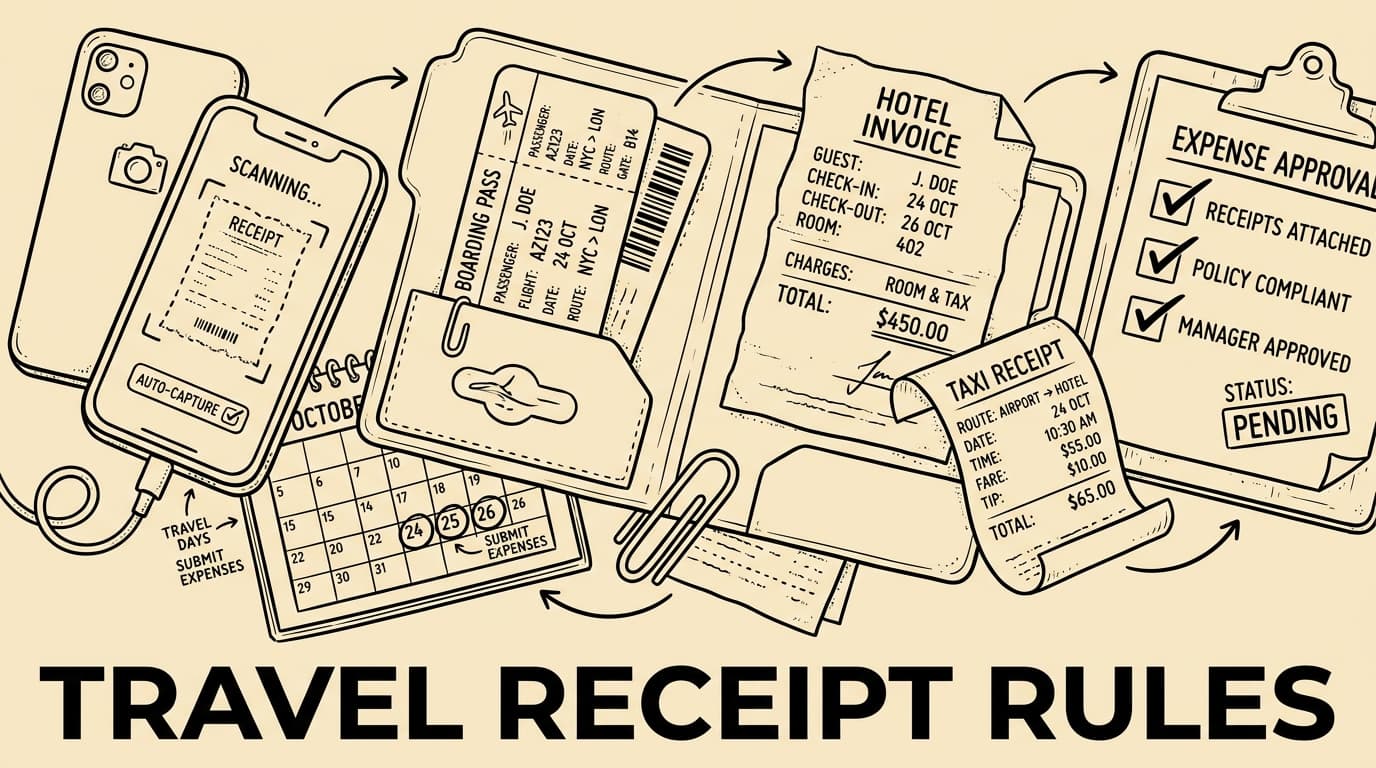
A receipt should normally identify the supplier, date, amount, currency, tax or VAT information where applicable, and a description of the goods or service. For hotels, the folio should separate room charges from breakfast, minibar, parking or city tax where those items are treated differently. For taxis and ride-hailing services, the receipt should show the route or trip reference when available. For air and rail, finance often needs the ticket or invoice plus proof that the journey took place, such as a boarding pass, itinerary or booking confirmation.
The rule should be written in plain language. Employees do not need a tax lecture at the point of travel; they need a checklist. A useful version is: keep the itemised receipt, not just the payment slip; photograph it on the same day; include the business purpose; add attendees for meals or hospitality; and submit it before the monthly cut-off. If a receipt is in a foreign language, employees should add a short note so approvers understand the expense without researching it later.
Original, scanned and digital receipts
Many jurisdictions accept electronic storage when records are complete, readable and protected from unauthorised change. That does not mean every photo is automatically audit-ready. The image must show the whole document, not cut off the supplier name, tax line or total. It should be stored in a system that keeps upload time, submitter, approver and later edits visible. A shared folder full of phone photos may be convenient, but it usually gives finance weak control over duplicates, retention and access.
A modern travel receipt rule can be digital-first. It can ask employees to capture receipts immediately, store the digital version in the expense tool and keep paper only where local rules or company risk policy require it. Tools like Bill.Dock support this by linking the receipt image, category, approval trail and export data in one workflow. The policy should still say what happens if the image is unreadable: finance can reject the claim, ask for a better copy or require a written missing-receipt declaration.
Rules by common travel category
Transport receipts should prove the journey and the cost. For flights, rail and rental cars, ask for invoices or booking documents that show traveller, date, route and amount. Fuel receipts should be separated from mileage reimbursement because the two methods compensate different costs. Parking, tolls and public transport can usually be simpler, but they still need date, amount and business purpose.
Accommodation receipts deserve more detail. A hotel folio may include private items that are not reimbursable under the company policy. The rule should require itemised hotel bills and should explain whether breakfast, laundry, gym access or late check-out can be claimed. Meals and client entertainment need the clearest guidance: who attended, why the meeting was business-related, whether alcohol is reimbursable and which spending limits apply.
When card statements are not enough
A corporate card statement proves that money left the card account, but it rarely proves what was purchased. A line that says “Hotel Berlin 243.00 EUR” does not show breakfast, minibar or VAT details. A restaurant card slip may show the payment amount but not attendees, business purpose or itemisation. Therefore the policy should say that card statements are supporting evidence, not a substitute for itemised receipts except for defined low-risk exceptions.
There are sensible exceptions. Some public transport machines do not issue detailed receipts, and some parking meters provide only a minimal ticket. The company can define thresholds and alternative evidence for these cases, such as a route note, calendar entry or app booking confirmation. The important point is consistency. If finance accepts a statement for one traveller and rejects it for another without a written rule, trust in the process declines.
Missing receipts and exception handling
Missing receipts will happen. The best policies do not pretend otherwise; they make exceptions controlled. A missing-receipt form should include the date, supplier, amount, category, business reason and a statement that the employee has not and will not claim the same expense elsewhere. Managers should see the exception before approval, and finance should track how often the same employee, team or supplier appears.
Exception rules should be proportionate. A small metro ticket without a receipt is not the same risk as a hotel bill or client dinner. Define what can be approved with an employee declaration, what requires senior approval and what cannot be reimbursed without original evidence. This keeps the policy fair while giving auditors a documented decision trail.
Deadlines, retention and month-end controls
Receipt rules only work if they include timing. Ask travellers to submit claims within a fixed window after the trip and before the month-end close. Late receipts create accrual problems, delay project costing and make currency conversion harder. A useful workflow sends reminders before the cut-off and routes overdue claims separately so finance can decide whether to accrue, reject or hold them for the next period.
Retention should be aligned with local tax and accounting requirements, but the article policy can state the operational principle: keep travel receipts for the period required by law and internal controls, store them in a searchable system and avoid deleting records simply because an employee leaves. Finance should be able to retrieve a specific hotel invoice, taxi receipt or meal claim by traveller, date, supplier and project without searching through email threads.
How to review travel receipts efficiently
Review starts before approval. The submitter chooses the right category, attaches the receipt and explains the business purpose. The manager checks business relevance and policy limits. Finance checks tax fields, duplicates, exchange rates, project coding and posting quality. Separating these roles prevents managers from becoming tax reviewers and prevents finance from judging business necessity after the trip is already done.
Automation can help without removing judgement. OCR can extract date, amount and supplier, duplicate checks can flag the same receipt image, and approval rules can route high-value or unusual claims to the right person. Finance still decides borderline cases, but the tool removes repetitive checks and creates a consistent audit trail. The policy should explain that automated checks support review; they do not replace employee responsibility for accurate submissions.
A practical travel receipt checklist
Before the trip, employees should know the spending limits and whether advances, company cards or personal cards are expected. During the trip, they should capture each receipt, check that the image is readable and add notes while the context is fresh. After the trip, they should submit one complete claim rather than a series of disconnected expenses, unless the policy asks for real-time submission.
Finance can publish a one-page checklist: itemised receipt attached; business purpose added; attendees listed for hospitality; currency visible; category selected; project or client code included; private items excluded; exception form used for missing receipts; claim submitted before the deadline. This simple list reduces back-and-forth more effectively than a long policy document that nobody reads while travelling.
FAQ
Is a photo of a receipt enough? It can be enough when the image is complete, readable and stored in a controlled system, but local rules and internal policy still matter. If the image cuts off tax details or the total, finance should ask for a better copy.
Can employees throw away paper receipts? Only if the company policy and local record-keeping rules allow digital retention for that receipt type. Conservative companies may keep paper for high-value or high-risk claims.
What should happen to private items on a hotel bill? Employees should exclude them or mark them as personal. The itemised folio is important because the card payment alone will not show which charges are private.
How can Bill.Dock help? Bill.Dock can centralise receipt capture, approval history, categories and export data so finance has one record instead of scattered emails and photos.
Conclusion
Corporate travel receipt rules work best when they are specific, short and easy to apply during a trip. Tell employees what evidence to keep, how to submit it, which exceptions are acceptable and why the rules exist. Then support the policy with a digital workflow that preserves the receipt, approval decision and accounting context together. The result is faster reimbursement, cleaner month end and a stronger audit trail without turning every trip into paperwork.