
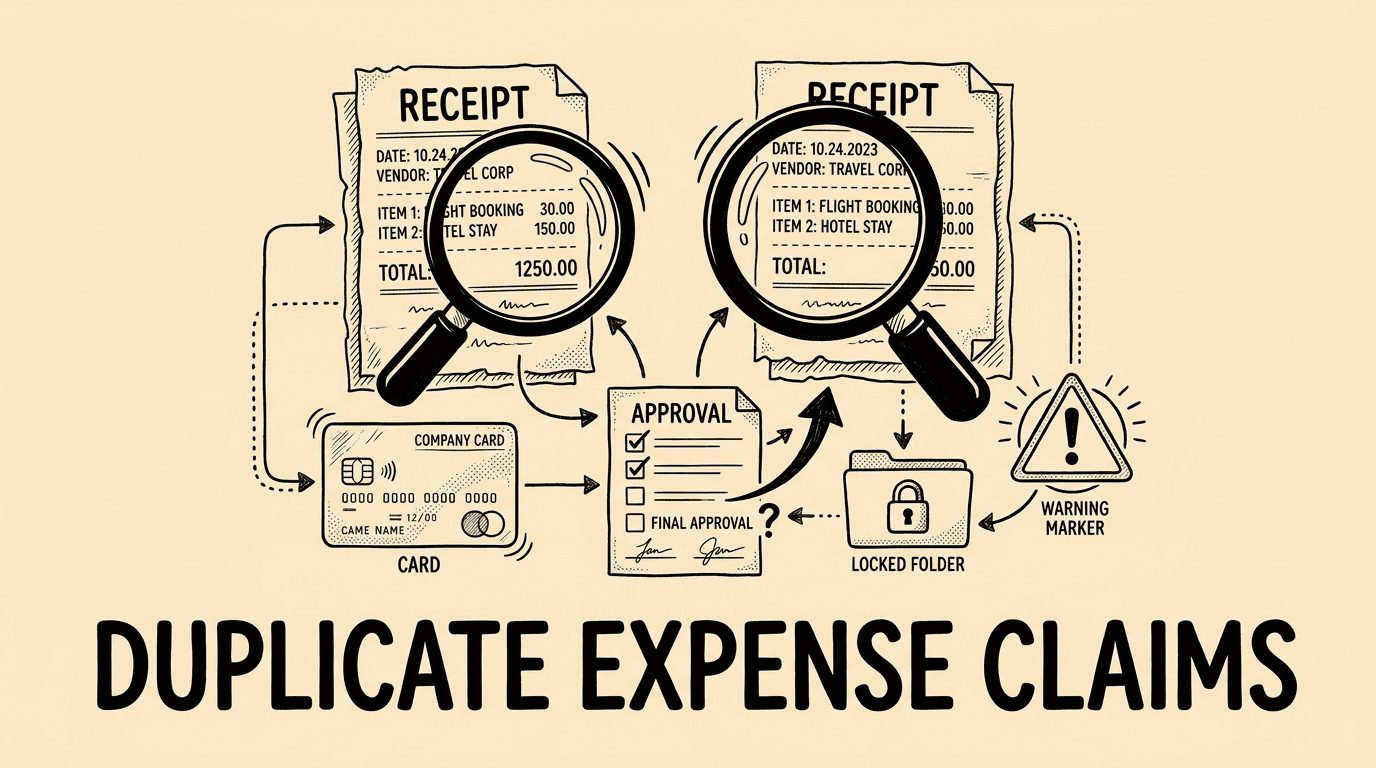
Duplicate expense claims rarely start as a dramatic fraud case. In most companies they begin with ordinary friction: a receipt is photographed twice, a card transaction is also reimbursed as an out-of-pocket expense, or a traveller submits the same taxi ride after a long week. The cost is not only the extra reimbursement. Finance also loses time checking exceptions, managers lose trust in the process, and month-end close becomes harder to defend.
The best control is therefore not a manual hunt at the end of the month. It is a workflow that makes duplicates difficult to submit, easy to spot, and simple to resolve with evidence. This guide shows how finance teams can design that workflow without turning every employee into an auditor.
Where duplicate claims come from
Duplicate claims usually appear at the boundary between channels. A team member pays with a company card, receives an email invoice, exports a PDF from a travel portal, and later uploads a photo from the phone. Each document looks legitimate on its own. The duplicate only becomes visible when amount, merchant, date, currency, payment method and claimant are compared together.
Another common source is delayed administration. Employees collect receipts during trips and submit them in a batch. If the original card feed has already been reconciled, the later upload can look like a new reimbursable expense. A good policy explains which payment types are reimbursable and which are card-only evidence for accounting.
- Compare receipt image, merchant, date, amount and payment method before reimbursement.
- Keep exception comments short, factual and visible to finance.
- Resolve honest mistakes quickly and reserve escalation for repeated patterns.
Build the policy before the exception queue
A duplicate-prevention policy should be short enough for employees to remember. It needs to define the original receipt, the allowed upload channels, the treatment of card expenses, and the point at which a document becomes final. The policy should also say what happens when an employee accidentally submits the same cost twice: correction first, escalation only when the pattern is repeated or unexplained.
For international teams, keep the control language practical rather than legalistic. VAT and invoicing rules differ by country, but finance always needs a readable document, a business purpose, a payment trail and a retention-ready record. The policy can link local tax guidance while keeping the everyday workflow consistent.
- Compare receipt image, merchant, date, amount and payment method before reimbursement.
- Keep exception comments short, factual and visible to finance.
- Resolve honest mistakes quickly and reserve escalation for repeated patterns.
Capture controls at upload
The upload moment is the cheapest place to stop a duplicate. Ask for the minimum fields that make matching reliable: date, merchant, amount, currency, payment method, project or cost centre, and employee. If receipt OCR is used, show the extracted values back to the employee before submission so mistakes can be corrected immediately.
Tools like Bill.Dock can support this by turning receipt capture into structured expense data. The important point is not that every field is perfect on the first scan. The important point is that finance receives comparable data instead of a folder of unrelated images. Comparable data makes duplicate detection possible before approval.
- Compare receipt image, merchant, date, amount and payment method before reimbursement.
- Keep exception comments short, factual and visible to finance.
- Resolve honest mistakes quickly and reserve escalation for repeated patterns.
Approval workflow design
Managers should not be asked to detect accounting duplicates from memory. Their role is to confirm business purpose, budget ownership and whether the expense fits policy. Finance or the expense system should handle technical matching. This split keeps approvals fast and reduces the temptation to rubber-stamp every receipt.
Use clear exception states. A claim can be submitted, waiting for information, suspected duplicate, approved, rejected, or reimbursed. When the state is visible, employees understand what is missing and finance can measure where the queue slows down.
- Compare receipt image, merchant, date, amount and payment method before reimbursement.
- Keep exception comments short, factual and visible to finance.
- Resolve honest mistakes quickly and reserve escalation for repeated patterns.
Matching logic finance can trust
A practical duplicate check combines exact and fuzzy signals. Exact matches include the same amount, date, merchant and employee. Fuzzy matches catch small variations: a receipt dated late at night but the card transaction posted the next morning, a merchant name shortened by a payment processor, or a foreign-currency conversion that changes the reported amount.
Do not rely on one signal alone. Two restaurant receipts on the same day may be legitimate. Two identical amounts from the same merchant with the same receipt image are much more suspicious. The workflow should show the evidence side by side so the reviewer can resolve the case quickly.
- Compare receipt image, merchant, date, amount and payment method before reimbursement.
- Keep exception comments short, factual and visible to finance.
- Resolve honest mistakes quickly and reserve escalation for repeated patterns.
Month-end and audit trail
Duplicate prevention is also a close discipline. At month-end, finance should review open suspected duplicates, unresolved card matches and reimbursements without proof of payment. The goal is not to create a large investigation file. The goal is to make sure the ledger reflects one economic event once.
Keep a record of decisions: who reviewed the exception, which documents were compared, what was changed, and why the claim was approved or rejected. This audit trail supports internal review and external bookkeeping requirements without relying on personal memory.
- Compare receipt image, merchant, date, amount and payment method before reimbursement.
- Keep exception comments short, factual and visible to finance.
- Resolve honest mistakes quickly and reserve escalation for repeated patterns.
Data protection and retention
Expense records often contain personal data: names, travel routes, payment details and sometimes health or location hints. Duplicate checks should therefore use only the data needed for finance control and keep it for the period required by accounting and tax rules. The GDPR principles of data minimisation and storage limitation are useful guardrails for European teams.
Access should be role-based. Managers need the business context for their team; finance needs reconciliation and reporting; employees need their own claims. Broad access makes investigations easier in the short term but increases privacy and governance risk.
- Compare receipt image, merchant, date, amount and payment method before reimbursement.
- Keep exception comments short, factual and visible to finance.
- Resolve honest mistakes quickly and reserve escalation for repeated patterns.
Implementation checklist
Start with the highest-volume categories: travel, meals, software subscriptions and mileage. Document the usual duplicate patterns for each category and configure the workflow around those patterns. Then train employees with concrete examples rather than abstract warnings.
A successful rollout does not need to accuse anyone. Position duplicate prevention as a way to reimburse faster, close cleaner and avoid awkward corrections later. When employees see that the system catches honest mistakes early, resistance drops.
- Compare receipt image, merchant, date, amount and payment method before reimbursement.
- Keep exception comments short, factual and visible to finance.
- Resolve honest mistakes quickly and reserve escalation for repeated patterns.
Frequently asked questions
Is every duplicate claim fraud?
No. Many duplicates are honest mistakes caused by multiple upload channels, delayed travel administration or unclear card rules. Treat first occurrences as corrections and investigate patterns.
Should finance block all similar expenses?
No. Similar expenses can be legitimate. The review should compare amount, merchant, date, claimant, payment method and receipt evidence before rejecting a claim.
Can duplicate prevention work without heavy surveillance?
Yes. Use finance-relevant fields, role-based access and transparent exception handling. The objective is accounting control, not employee monitoring.
Where does Bill.Dock fit?
Bill.Dock helps teams capture receipts, structure expense data and maintain an audit-ready record so duplicate checks happen before reimbursement rather than after close.
Next step
If duplicate expense claims are slowing down your close, start with better capture and a clearer exception queue. Bill.Dock helps finance teams turn receipts into structured, reviewable records so the same cost is not paid twice.
Conclusion
Duplicate-claim prevention works best when it is calm, visible and evidence-based. Clear rules tell employees what to submit, structured capture gives finance comparable data, and a focused exception queue keeps close work under control. The result is not a culture of suspicion. It is a cleaner expense process where honest mistakes are corrected early and repeated issues have a documented review path.
Review a small sample of approved expenses each month and compare it with card feeds and reimbursement exports. Sampling keeps the control honest without slowing every claim. Document the decision in the same system so the next reviewer sees the history, the compared fields, and the reason for the outcome.
Use category-specific rules because mileage, meals, subscriptions and travel receipts fail in different ways. A single global rule creates too many false positives. Document the decision in the same system so the next reviewer sees the history, the compared fields, and the reason for the outcome.
Review a small sample of approved expenses each month and compare it with card feeds and reimbursement exports. Sampling keeps the control honest without slowing every claim. Document the decision in the same system so the next reviewer sees the history, the compared fields, and the reason for the outcome.