
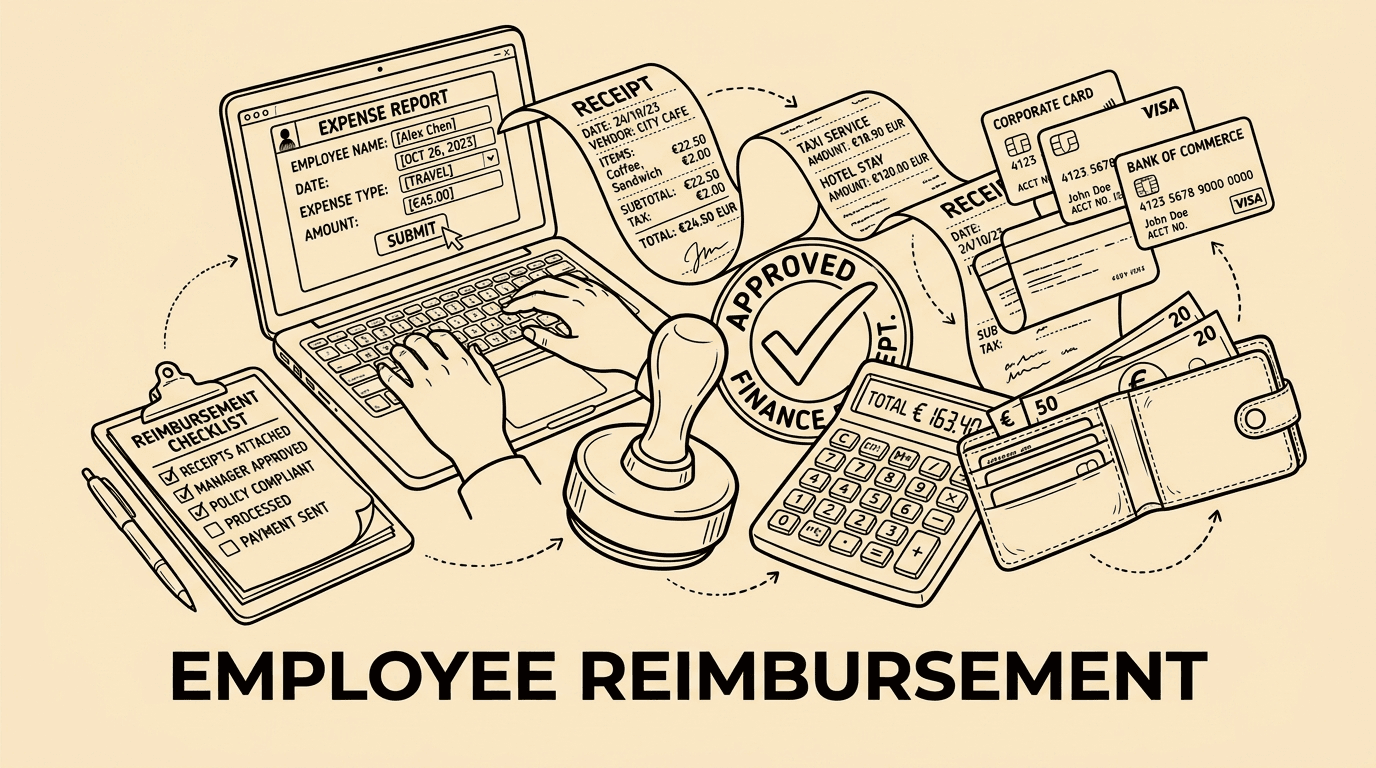
Every business, regardless of size, must handle employee reimbursements at some point. Whether your team travels for client meetings, purchases office supplies, or covers work-from-home costs, having a clear, fair, and efficient employee reimbursement process protects both your organisation and your staff. A poorly managed reimbursement workflow leads to delayed payments, frustrated employees, compliance risks, and mounting administrative overhead.
This guide walks you through every stage of a professional employee reimbursement process, from policy creation to payment, including how modern expense management tools can dramatically cut the time spent on manual tasks.
What Is an Employee Reimbursement Process?
An employee reimbursement process is the formal system through which a company pays back employees for legitimate business expenses they have incurred with their own money. Unlike corporate cards, which charge expenses directly to the company, reimbursable expenses require employees to pay out of pocket first and then submit a claim for repayment.
Common reimbursable expenses include:
- Business travel costs (flights, trains, hotels, taxis)
- Meals and entertainment during client visits
- Office supplies purchased for remote work
- Professional development and training fees
- Mileage for using a personal vehicle on company business
- Communication tools such as mobile data plans or home internet
The process must be consistent, transparent, and timely to maintain employee trust and satisfy tax and accounting requirements across the UK, EU, and internationally.
Why a Structured Reimbursement Process Matters
Many companies underestimate the impact that a poorly designed reimbursement workflow has on staff morale and financial accuracy. Studies consistently show that employees who wait more than three weeks for reimbursement become noticeably less satisfied with their employer. Worse, a significant percentage of expense claims submitted without a formal process contain errors, duplicate entries, or missing documentation.
A structured process provides several tangible benefits:
- Compliance: HMRC in the UK, Finanzbehörden in Germany, and tax authorities across Europe require businesses to keep valid receipts for a minimum of five to seven years. A documented process ensures your records are audit-ready.
- Cost control: Clear spending limits and approval workflows prevent unauthorised or excessive expenditure before it hits the books.
- Employee satisfaction: Fast, predictable reimbursement cycles mean employees are not financing the company with their personal funds indefinitely.
- Accounting accuracy: Categorised expense submissions feed directly into your profit-and-loss statements and VAT returns, reducing month-end reconciliation effort.
Step 1: Build a Clear Expense Policy
The foundation of any reimbursement process is a written expense policy. This document defines which expenses are eligible, what the spending limits are, and what documentation employees must provide. Without a policy, every claim becomes a negotiation, and inconsistency creates resentment across teams.
Your expense policy should cover:
- Eligible expense categories: List exactly what is and is not reimbursable. Ambiguity is the enemy of a smooth process.
- Spending limits per category: Set daily meal caps, maximum hotel rates per city, and mileage rates aligned with current HMRC approved amounts (or the equivalent for your country).
- Submission deadlines: Require employees to submit claims within 30 days of the expense date. Older claims are harder to verify and complicate quarterly accounts.
- Receipt requirements: Specify that all expenses above a threshold (commonly EUR 25 or GBP 20) require an original receipt, not just a bank statement line.
- Approval hierarchy: Define who approves whose expenses. Line managers typically approve their reports; finance approves manager expenses and any claim above a set threshold.
Review and update your expense policy at least annually, or whenever tax rates, per-diem allowances, or company travel patterns change significantly.
Step 2: Make Submission Easy for Employees
The biggest bottleneck in most reimbursement processes is the submission step. If employees must complete paper forms, manually attach receipts, and walk them to a manager's desk, claims pile up or disappear entirely. The solution is a frictionless digital submission channel.
Best practice submission requirements:
- A mobile-first expense form that takes under two minutes to complete
- Photo upload for receipts directly from a smartphone camera
- Automatic category suggestions based on merchant name or amount
- Clear confirmation when a submission is received and being reviewed
Tools like Bill.Dock offer receipt scanning and automatic data extraction, turning a photo of a restaurant bill into a structured expense record with merchant name, date, amount, and currency already populated. This single improvement typically reduces submission time from five minutes to under sixty seconds per expense.
Step 3: Define a Multi-Level Approval Workflow
Not all expense claims carry the same risk. A EUR 15 taxi receipt needs far less scrutiny than a EUR 4,000 international flight. Your approval workflow should reflect this reality by routing claims to the appropriate level of oversight automatically.
A typical tiered approval structure looks like this:
- Tier 1 (under EUR 100 / GBP 80): Auto-approved if the expense is within a pre-approved category and the employee has no outstanding compliance issues.
- Tier 2 (EUR 100–500 / GBP 80–400): Requires direct manager approval, ideally within 48 hours.
- Tier 3 (over EUR 500 / GBP 400): Finance or department head approval required, with a note on business purpose.
- Exception tier: Any claim outside the normal policy (unusual category, over the limit, missing receipt) is flagged automatically and routed for special review.
Approvers should receive email or mobile notifications with the full claim detail and a single-click approve or reject function. The fewer friction points in the approval step, the faster claims move through the system.
Step 4: Process Payments on a Clear Schedule
Approved expense claims must be paid promptly. Employees who paid EUR 800 for a business flight expect to see that money returned within a predictable window. Best-in-class companies process reimbursements on a weekly or bi-weekly cycle, aligned with payroll.
Payment options include:
- With payroll: Reimbursements are added to the monthly or fortnightly payslip. Administratively simple, but can mean a 4-week wait for some employees.
- Dedicated weekly transfer: Finance runs a separate bank transfer batch every Friday for all approved claims from the past week. Faster and more predictable.
- On-demand payment: For large-value reimbursements, some companies process payments the same day approval is granted. This is especially important when an employee has funded a significant business expense.
Whatever schedule you choose, communicate it clearly in your expense policy and stick to it. Consistency builds trust. Late or irregular payments, even when eventually made, damage employee confidence in the process.
Step 5: Maintain Compliant Records
Tax authorities in every major market require businesses to retain expense documentation for a minimum period. In the UK, HMRC requires six years of records. In Germany, GoBD mandates seven to ten years of retention with strict requirements on the integrity and readability of digital records. Across the EU, the standard is at least five years, though individual member states often exceed this.
Compliant record-keeping means:
- All receipts are stored digitally in a format that cannot be altered after submission
- Each expense record includes the date, amount, currency, business purpose, and supplier
- The system creates an audit trail showing who submitted, who approved, when, and when payment was made
- Records can be exported in a format acceptable to your tax advisor and relevant authorities
Manual filing systems make this extraordinarily difficult, particularly for businesses operating across multiple countries. Digital expense management platforms with built-in archiving and audit logs are the only scalable solution for multi-year compliance requirements.
Step 6: Automate Reconciliation and Reporting
Once reimbursements are paid, the accounting work begins. Each expense must be categorised, allocated to the correct cost centre or project, and reconciled against bank statements. For finance teams handling hundreds of expense claims per month, manual reconciliation is a significant time sink and a source of errors.
Automated reconciliation features to look for include:
- Automatic mapping of expense categories to your chart of accounts
- Project or cost-centre tagging at point of submission
- Integration with accounting software such as DATEV, Xero, QuickBooks, or Sage
- One-click generation of VAT summary reports for quarterly returns
- Anomaly detection flagging unusually high claims, duplicate submissions, or spending spikes
A well-connected expense management system turns end-of-month reconciliation from a two-day manual effort into a two-hour review and approval task.
Common Mistakes in Employee Reimbursement Processes
Even companies with good intentions make systematic mistakes that undermine their reimbursement workflows. The most frequent errors include:
- No receipt, no reimbursement — but no enforcement: Policies that require receipts are meaningless if managers routinely approve claims without them. Finance must have the authority to reject incomplete submissions.
- Inconsistent category definitions: When the same expense is categorised differently by different managers, your accounting data becomes unreliable and VAT recovery becomes complicated.
- Missing mileage logs: HMRC and equivalent authorities require a mileage log showing the journey purpose, start point, end point, and distance. A round number on an expense form is not sufficient.
- Delayed submissions creating stale claims: A EUR 3,000 client dinner submitted 90 days after the event is difficult to verify, complicates quarterly accounts, and may not meet tax authority requirements for documentation timeliness.
- No training for new employees: Staff who have never used your system make the most mistakes. A short onboarding session on expense submission prevents recurring issues.
Benchmarking: Key Reimbursement Metrics
Finance teams that track reimbursement KPIs consistently outperform those that do not. Monitor these metrics: average time from submission to payment (best-in-class under 5 days; industry average 15 days), error rate on submitted claims (top performers under 3%; manual processes 15–20%), policy compliance rate on first submission (target above 90%), and processing cost per claim (manual EUR 50–75; automated under EUR 15).
GDPR and Data Protection in Expense Management
Employee expense data contains personal information, including travel patterns, meal preferences, and purchasing behaviour. Under GDPR and equivalent data protection laws, businesses must handle this data lawfully, transparently, and securely. Key obligations include: storing expense data only for as long as legally required for tax purposes, restricting access to expense records to those with a legitimate business need, and ensuring that any third-party expense management platform you use is GDPR-compliant with a valid data processing agreement in place.
Frequently Asked Questions
How long should the reimbursement process take?
Best practice is payment within five business days of approval. For larger organisations with weekly payment runs, the maximum acceptable cycle is ten business days. Anything beyond two weeks regularly triggers employee dissatisfaction.
Are all business expenses automatically tax-deductible?
No. Eligibility for tax deduction depends on the nature of the expense, the jurisdiction, and the documentation quality. Client entertainment, for example, is often only 50% deductible, and some categories are entirely non-deductible. Always consult your tax advisor for jurisdiction-specific rules.
What should I do if an employee loses a receipt?
Most tax authorities accept a written declaration signed by the employee explaining the lost receipt, the nature of the expense, and the amount. However, this should be a rare exception, not a routine workaround. Digital receipt capture at the point of purchase eliminates this problem.
Can reimbursements be paid in a currency other than the employee's home currency?
Yes, but the exchange rate used must be documented. Use the official exchange rate published by your central bank or a recognised financial institution on the date the expense was incurred, and retain this rate documentation alongside the original receipt.
When should we switch from a spreadsheet to dedicated expense software?
If your team submits more than 30 expense claims per month, or if you operate across more than one country, dedicated expense management software will save significant time and reduce errors. The ROI is typically positive within the first three months of adoption.
Conclusion
A well-designed employee reimbursement process is not a back-office afterthought. It is a direct expression of how your company values its people. Clear policies, digital submission tools, transparent approval workflows, and reliable payment schedules create an experience that employees trust and finance teams can manage efficiently. Tools like Bill.Dock automate the most time-consuming steps, from receipt capture to accounting exports, turning a historically painful process into a smooth, compliant workflow that scales with your business.