
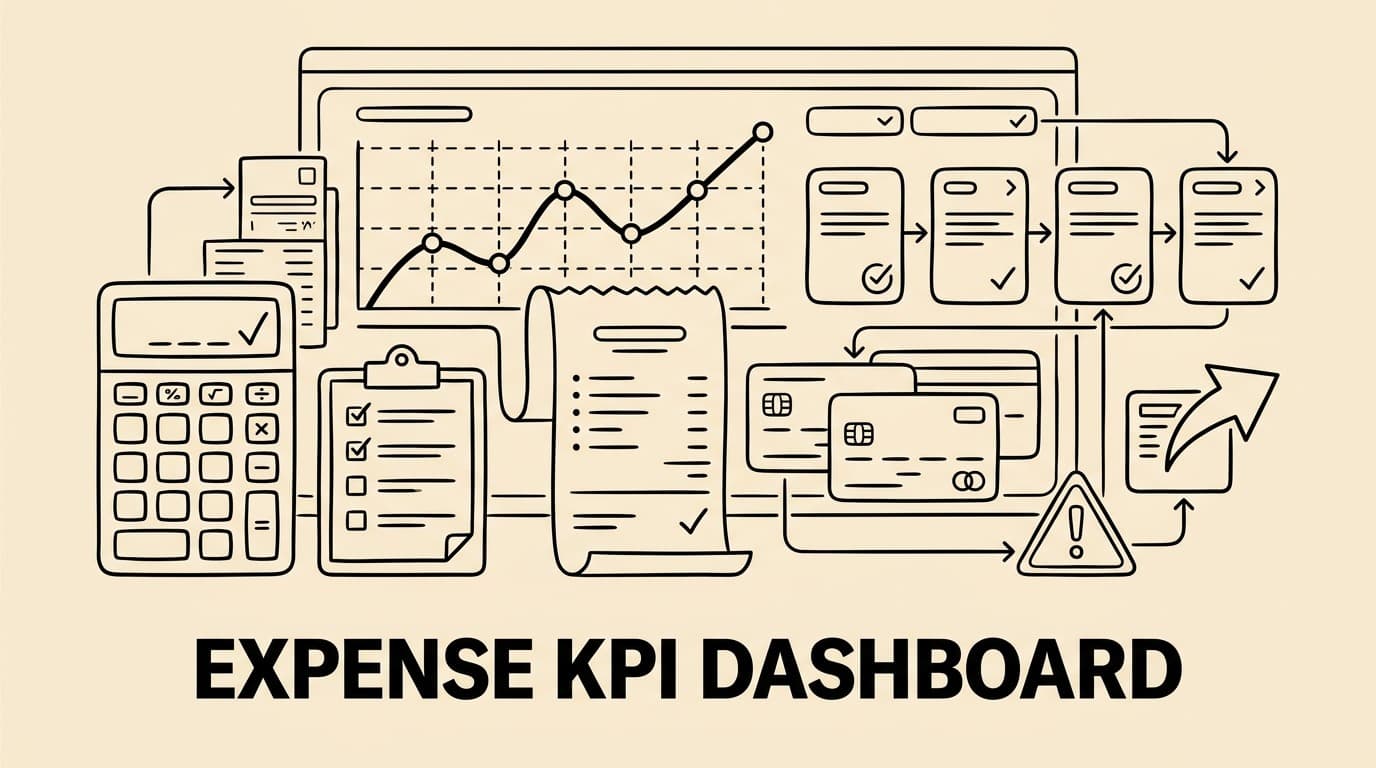
Why expense KPIs need their own scorecard
Expense management is often measured only when something breaks: a late reimbursement, a missing receipt, a policy dispute or a month-end close that waits for card transactions to be explained. That is too late for a finance team that wants predictable cash control and clean accounting data. A practical KPI set turns expenses from a pile of claims into an operating system with visible throughput, quality and risk signals.
The best scorecard is not a wall of vanity metrics. It is a short set of measures that a controller, CFO and operations lead can review in the same meeting. Each metric should answer one business question: are employees submitting complete claims quickly, are managers approving within the agreed window, are exceptions being resolved before payroll or card settlement, and can accounting close without chasing evidence? Tools like Bill.Dock help because the receipt, category, policy check and export status live in one workflow instead of separate spreadsheets.
1. Submission cycle time
Submission cycle time measures the time between a transaction date and the moment the employee submits a complete expense. It is the earliest warning that the process is drifting. When the average looks healthy but the upper quartile is high, the team may have a small group of frequent travellers or card users who keep delaying receipts until the month is almost closed.
Track the median, the 75th percentile and the number of claims older than your internal threshold. The threshold depends on your policy: many teams use a few business days after a trip or card purchase, while month-end cut-offs may be stricter. The KPI is useful only when it is tied to behaviour. Send reminders before the cut-off, make mobile receipt capture easy and separate genuine missing receipts from simple procrastination.
2. Approval turnaround time
Approval turnaround time starts when a complete claim reaches the responsible approver and ends when it is approved, rejected or returned. Slow approval is not just an employee-experience issue. It delays reimbursement, slows cost visibility and can push accounting entries into the wrong reporting period.
Measure the whole flow and each step separately: manager review, finance review and payment release. If the manager step is slow, clarify delegation and out-of-office rules. If finance review is slow, the problem is usually data quality, unclear categories or too many manual policy checks. A good KPI dashboard therefore shows both time and reason codes so the team can improve the bottleneck, not just complain about it.
3. First-time-right rate
First-time-right rate is the share of expense claims that pass review without being returned for missing receipts, wrong cost centres, unclear tax treatment or policy questions. It is one of the most practical quality metrics because every returned claim creates rework for the employee, approver and finance team.
GBTA has reported that roughly 19 percent of expense reports contain errors and that correcting reports with errors can take time and money. Use that type of external benchmark as context, not as a target copied into your company. Your own baseline matters more. Split the metric by claim type, department and payment method. If card transactions have better data than cash claims, the process can lean further toward card controls. If a department repeatedly misses project codes, fix the default coding rules rather than sending another generic reminder.
4. Policy exception rate
The policy exception rate shows how often submitted expenses break a rule or require special approval. It should include out-of-policy spend, missing receipts above the allowed threshold, late submissions, unusual merchant categories and claims that require a manual override.
A useful exception metric separates acceptable business exceptions from preventable behaviour. A client dinner above the normal limit may be approved because the context is documented. A hotel minibar charge or duplicate taxi receipt should not disappear into a generic misc bucket. Track exception type, monetary exposure and approval outcome. Over time the KPI tells you whether the policy is too vague, too strict or simply not embedded in the workflow.
5. Receipt completeness and evidence quality
Receipt completeness measures whether each claim has the evidence needed for audit, VAT, tax and internal control. Evidence quality goes one level deeper: is the document readable, does it show date, merchant, amount and tax information, and can it be matched to the transaction without interpretation?
This KPI matters because a finance team can have fast approvals and still create audit risk. Count missing receipts, unreadable scans, incomplete invoices, screenshots that do not qualify as receipts and documents that do not match the claimed amount. Automation should reduce the noise by reading receipt fields, flagging gaps and attaching the original file to the export record. The goal is not to reject more claims; it is to catch evidence issues while the employee still remembers the purchase.
6. Duplicate and unusual-claim indicators
Duplicate claims are usually a process weakness before they are a fraud case. The same receipt can be uploaded twice, a card transaction can be reimbursed again as a cash claim, or a hotel invoice can be split across categories. A duplicate indicator should compare merchant, amount, date, receipt image and employee across open and historical claims.
Unusual-claim indicators are broader. They include round amounts, weekend purchases, merchant categories outside the employee role, sudden spikes before a cut-off and claims just below approval limits. Do not turn the KPI into an accusation engine. Use it as a review queue with documented outcomes: valid, corrected, rejected or policy updated. That history is more valuable than a red flag count on its own.
7. Reimbursement and payment punctuality
For reimbursable expenses, employees care about one KPI more than any dashboard: when will they be paid? Reimbursement punctuality measures the share of approved claims paid within the promised service level. It should be reported separately from approval time so the team can see whether delays happen before or after approval.
For company-card expenses, the equivalent KPI is settlement readiness. Are transactions coded, approved and supported before the card statement or direct-debit date? A late card close can force accounting to book accruals, chase managers or postpone reconciliation. Finance leaders should review both employee-facing punctuality and accounting-facing readiness because they affect trust in different ways.
8. Category, cost-centre and tax accuracy
Expense data is useful only if the coding is reliable. Category accuracy measures whether meals, travel, software, office supplies and other categories are classified consistently. Cost-centre accuracy checks whether the expense lands in the right team, project or client. Tax accuracy checks whether VAT or sales-tax treatment is complete enough for local rules.
This KPI should be sampled and reviewed, not guessed. Take a monthly sample of claims, compare the coding to accounting rules and record the correction rate. If the same correction appears repeatedly, change defaults, merchant rules or employee guidance. APQC’s accounts-payable benchmarking framework is a useful reminder that process cost includes people, systems, overhead and outsourced effort; wrong coding increases those costs even when the visible claim count stays stable.
9. Month-end close readiness
Month-end close readiness is a composite KPI that answers a simple question: can the team export complete, approved and coded expenses by the close deadline? It combines open claims, unapproved card transactions, missing receipts, pending exceptions and export errors.
This is often the most executive-friendly metric because it links expense operations to financial reporting. A green close-readiness score means accounting can book expenses in the right period with less chasing. A red score tells the CFO that the expense process is now a close risk. Keep the formula transparent. For example: approved and coded claims, plus card transactions with evidence, minus unresolved exceptions and export failures.
10. How to build a dashboard without creating reporting overhead
Start with eight to ten KPIs, not thirty. Assign an owner, a formula, a data source and a review cadence to each measure. If the number cannot be produced from the expense workflow, card feed or accounting export without manual spreadsheet work, it will not survive busy periods.
A practical weekly dashboard can show: submission cycle time, approval turnaround, first-time-right rate, exception rate, receipt completeness, duplicate queue, payment punctuality, coding accuracy and close readiness. Review trends, not single-day noise. When a metric moves, ask for the process cause and the next action. Bill.Dock-style workflows are strongest when they make these signals operational: reminder sent, claim returned, receipt requested, exception approved, export completed.
Implementation checklist for finance teams
Define the policy thresholds before you define the chart. Decide what counts as late, incomplete, duplicate, out of policy and close-ready. Document the formula in plain language so managers trust the dashboard. Separate employee behaviour metrics from finance-process metrics; otherwise the conversation becomes defensive.
Run the first month as a baseline. Do not set aggressive targets until you know the real distribution. In month two, pick two improvements: for example reducing claims older than seven days and cutting missing receipts in one department. In month three, add automation or default coding changes where the data proves a repeated pattern. The KPI programme should feel like process improvement, not surveillance.
FAQ
How many expense management KPIs should a finance team track? Most teams should start with eight to ten core KPIs. More metrics are useful only if someone owns the action behind them.
Should expense KPIs be reviewed weekly or monthly? Operational metrics such as late submissions and approval queues work well weekly. Close readiness, coding accuracy and trend analysis are usually reviewed monthly.
Are benchmarks necessary? Benchmarks help frame the conversation, but internal baseline and trend matter more. A smaller company may have different thresholds from a multinational travel programme.
Can automation replace policy training? No. Automation can flag missing data, route approvals and reduce manual checks, but employees still need a clear policy and simple examples.
Conclusion
Expense management KPIs work when they connect finance control to daily behaviour. The strongest scorecards measure speed, quality, risk and close readiness in the same view. They also make the next action obvious: remind, approve, correct, reject, reimburse or export. Start small, use clean definitions and let the dashboard guide process changes rather than becoming another reporting exercise.
Bill.Dock helps finance teams capture receipts, standardise review queues and export cleaner expense data without turning KPI reporting into another spreadsheet process.