
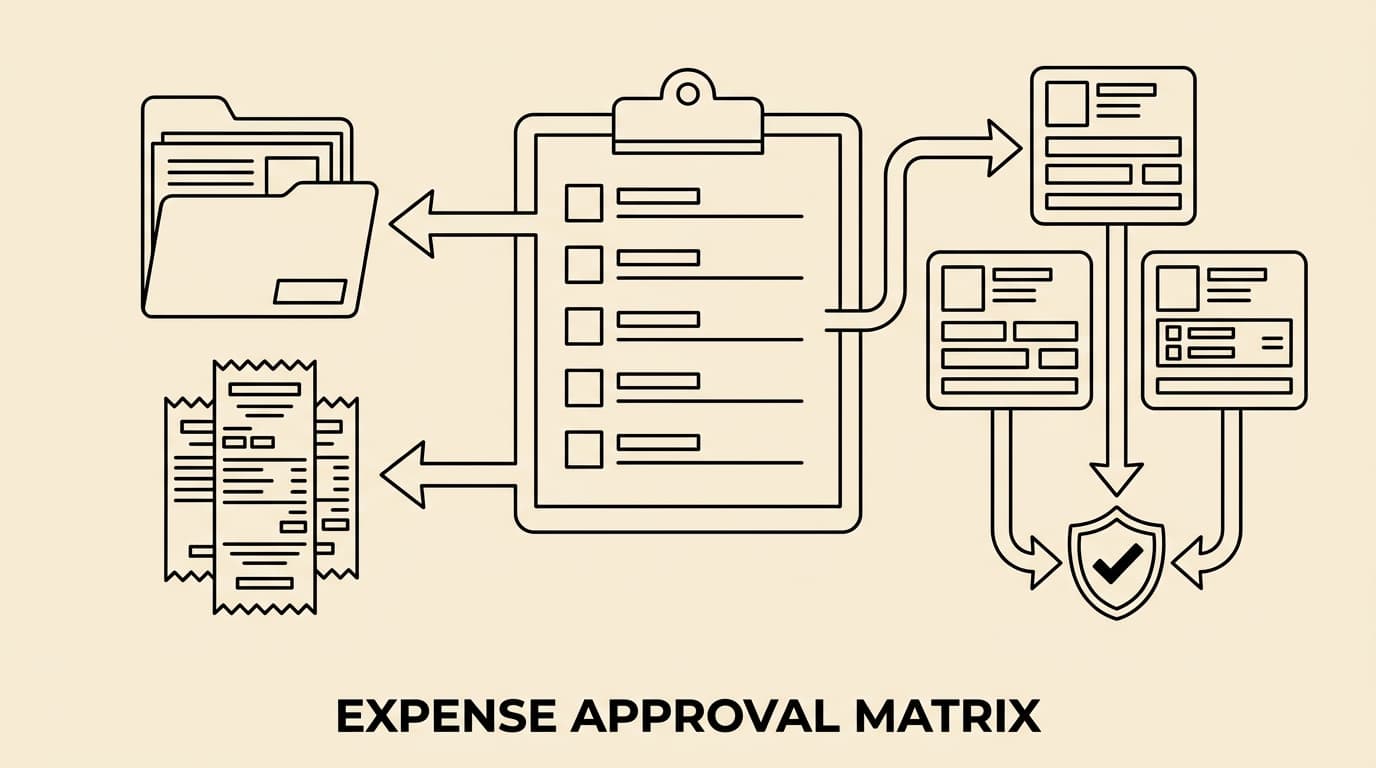
Why an approval matrix belongs in the expense policy
An expense policy explains what employees may buy, but an expense approval matrix explains who can say yes. That distinction matters when the business grows beyond a handful of verbal approvals. Without a matrix, every receipt becomes a small negotiation: one manager approves a meal, another rejects the same situation, and finance receives late context during month end. A matrix turns judgement into a documented operating rule. It connects spend category, amount, role, cost centre and risk level to a named approval route, so the employee, manager and accountant all see the same expectation before money is committed.
For finance teams, the value is not bureaucracy. The value is consistency and evidence. A good matrix reduces Slack-based exceptions, prevents senior approvers from seeing tiny routine claims, and keeps material or unusual spend visible to the right person. It also creates a clean audit trail: the claim was submitted with a receipt, checked against policy, routed according to threshold, approved by the responsible owner and exported with the decision history. That evidence is hard to reconstruct from email threads after the fact.
Start with spend categories, not job titles
The most common design mistake is to begin with a hierarchy chart. Job titles are useful, but they do not describe financial risk. A taxi after a client dinner, a software subscription, a replacement laptop charger and a hotel deposit all create different questions. Start by listing the spend categories that actually appear in your receipts: travel, accommodation, meals, mileage, home-office equipment, client entertainment, subscriptions, training and emergency purchases. Then decide which categories need light review and which need specialist or budget-owner review.
This category-first approach also helps localise the policy. In DACH teams, VAT evidence and GoBD-style document retention may be more important than the label on the approver. In international teams, foreign currency, cross-border tax evidence and card fees can change the approval route. The matrix should therefore say more than “manager approves”. It should state the category, documentation requirement, threshold, approval owner and escalation trigger in one readable line.
Define thresholds that match financial materiality
Thresholds should be simple enough that employees remember them and specific enough that finance can enforce them. Many teams use three layers: routine low-value spend, manager-approved spend and finance or leadership approval for high-value or unusual items. The exact amounts depend on company size, country, industry and risk appetite, so the article should avoid universal limits. What matters is that the thresholds are documented, reviewed and aligned with budget ownership. A team lead should not approve a cost that belongs to another budget simply because the amount is small.
A useful test is to walk through last month’s receipts and ask whether the threshold would have routed each claim to the person who could make a responsible decision. If too many low-risk claims land with finance leadership, the matrix will slow the business down. If too many unusual claims stay with direct managers, the business loses control. The right matrix is therefore a balancing instrument, not a wall.
Separate pre-approval from reimbursement approval
Pre-approval and reimbursement approval are often confused. Pre-approval answers “may this employee commit the spend?” Reimbursement approval answers “does this submitted claim match the approved spend and policy evidence?” A conference ticket may need pre-approval before purchase, while the later reimbursement still needs a receipt, attendee purpose and tax details. Combining both decisions into a single step can hide important evidence gaps.
Your matrix should state which categories require pre-approval before purchase. Typical candidates are travel bookings, equipment, subscriptions, client entertainment and any purchase above a material threshold. Reimbursement approval can then focus on completeness: receipt present, date and amount match, business purpose stated, correct category selected, VAT or tax evidence captured and no duplicate claim exists. Tools like Bill.Dock help here by keeping the receipt, approval status and export context together instead of spreading them across inboxes.
Map roles and backups before the first exception
Every approval route needs a primary approver and a backup. People travel, leave the company, change teams or become the subject of their own claim. If the matrix only names a department head, finance may discover during close that the approver is unavailable. Define backups by role rather than by personal favour: direct manager, cost-centre owner, finance reviewer, project lead or managing director. For claims submitted by an approver, the route should automatically move one level up or sideways to an independent owner.
Backups are also useful for small entities where roles overlap. The same person may be founder, budget owner and card holder. In that case the matrix can still create control by requiring a second reviewer for high-value or unusual spend, or by letting the tax advisor review the evidence package before posting. The key is that the route is written down before pressure arrives.
Build an exception lane instead of approving by workaround
No policy catches every real-world situation. Employees lose receipts, trips change, cards fail and urgent purchases happen outside the normal vendor process. The question is whether exceptions become invisible workarounds or documented decisions. A strong matrix includes an exception lane with clear criteria: what must be explained, who may approve, which documents are still required, and when finance may reject or hold the claim.
The exception lane should be narrower than the normal lane. It should capture the reason, the approving person, the date, any compensating evidence and whether the exception should change the policy later. This turns exceptions into feedback rather than noise. If the same exception appears every month, the policy may be unrealistic; if only one team creates exceptions, that team may need training or a budget review.
Documentation fields that make approvals audit-ready
An approval is only as good as the evidence attached to it. The matrix should specify which fields finance needs before a claim can move forward: supplier, date, amount, currency, tax amount if relevant, cost centre, project, business purpose, attendee names for entertainment, travel route for mileage and proof of payment where required. These fields are not decorative. They allow accountants to code the transaction, tax advisors to assess deductibility and managers to understand why the spend belongs to their budget.
Keep the wording practical. Employees do not need a legal essay on every claim, but “business lunch” is weaker than “client onboarding lunch with ACME project team”. “Software” is weaker than “monthly project-management subscription for operations team”. The matrix can define the level of detail expected for each category, which reduces back-and-forth after submission.
Use the matrix as a monthly close control
Finance should not only use the approval matrix at the moment of submission. It can become a month-end control. Before close, review open claims by approval state: submitted but missing receipt, approved but not exported, rejected but still on the employee balance, exception pending finance review and card transaction unmatched to receipt. This view helps finance clear bottlenecks before the accounting deadline instead of discovering them during reconciliation.
A practical close routine is to run a short approval aging list two or three times during the month. Managers see what waits for them; employees see what evidence is missing; finance sees which exceptions need a final decision. The matrix gives the routine authority because everyone can see the rule behind the reminder.
Implementation checklist for the first version
Keep the first version smaller than the final ambition. Choose five to eight spend categories, three threshold bands and a defined exception path. Test the matrix on recent claims, adjust obvious gaps, then publish it with examples. Employees should be able to answer three questions without asking finance: Do I need approval before spending? Who approves the claim after submission? Which evidence must I attach?
After launch, review the matrix after one or two closes. Look for claims that were delayed, managers who approved outside their budget, categories with repeated missing information and exceptions that became routine. The review should update the matrix, not blame employees for rules that were unclear.
Example approval matrix structure
| Category | Routine route | Escalation trigger | Evidence |
|---|---|---|---|
| Travel | Manager and cost-centre owner | High-value, international or changed itinerary | Receipt, purpose, dates, traveller |
| Meals and client entertainment | Manager review | Missing attendees or unusual amount | Receipt, business purpose, attendees |
| Software subscriptions | Budget owner | New vendor or recurring contract | Invoice, owner, team need |
This structure is intentionally simple. It is not a legal template; it is a working model finance can adapt to its own countries, tax rules and governance requirements.
From matrix to workflow
A PDF matrix is useful, but the control only works when claims follow it in daily operations. Bill.Dock helps finance teams capture receipts, keep approval status visible, preserve comments and export cleaner records. That makes the matrix easier to enforce without turning every claim into a manual chase.
FAQ
Should every expense need manager approval? Not necessarily. Very low-risk recurring spend can be reviewed by finance controls or card rules, while higher-risk categories need named approval. The matrix should match risk rather than create approvals for their own sake.
Can finance approve instead of the manager? Finance can check policy and evidence, but budget ownership usually sits with the manager or cost-centre owner. A good workflow separates evidence review from business approval.
How often should the matrix be updated? Review it whenever the organisation changes, after repeated exceptions, and at least during regular policy reviews. The best trigger is operational evidence, not a calendar alone.
Where does Bill.Dock fit? Bill.Dock helps teams capture receipts, route claims, keep status visible and export cleaner records, so the approval matrix becomes a working process rather than a PDF employees forget.