
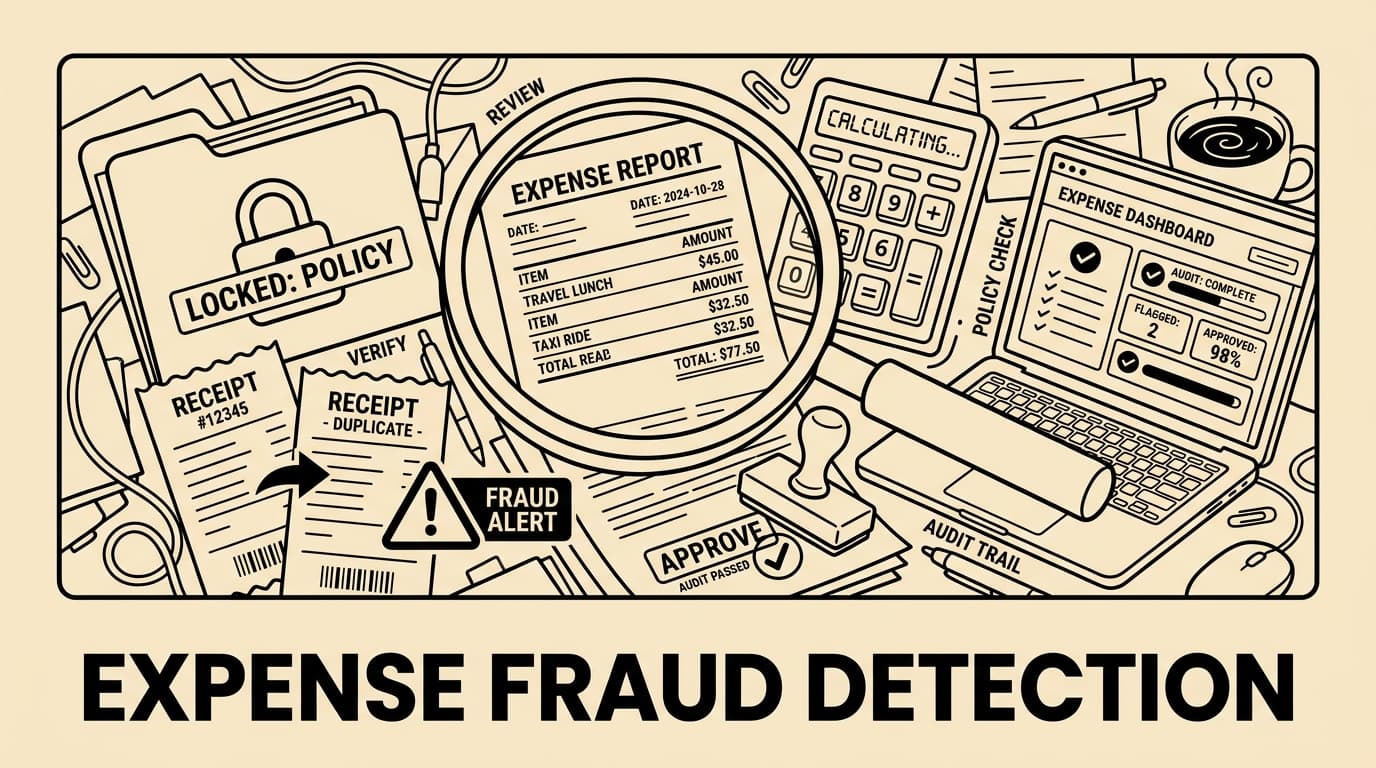
Expense report fraud rarely starts with a dramatic scheme. More often it starts with a missing receipt, a vague business purpose, a rounded amount, or a claim submitted weeks after the trip. For finance teams, the challenge is to separate honest mistakes from patterns that put cash, tax records, and trust at risk.
A modern fraud detection process is not about treating every employee like a suspect. It is about making the right behaviour easy, applying the same rules consistently, and giving reviewers enough context to approve expenses quickly. This guide explains the red flags, controls, and review routines that help small and mid-sized teams prevent reimbursement abuse without creating a slow bureaucracy.
What expense report fraud looks like in daily work
The most useful controls are simple enough to apply every month and specific enough to create comparable evidence across the team.
- Duplicate claims for the same taxi, hotel, meal, parking ticket, or software subscription.
- Personal purchases described as client meetings, office supplies, or travel necessities.
- Inflated mileage, per diem, tips, exchange rates, or cash amounts that cannot be tied to a reliable source.
- Receipts split across several reports to stay below approval thresholds.
- Claims submitted long after the event, when the business purpose and participants are hard to verify.
For mileage or travel claims that depend on meetings, site visits or events, finance teams can also compare the claim against calendar evidence. If an employee provides an exported .ics file or meeting invite, an online ICS file viewer can help reviewers inspect the event details without importing the file into a company calendar.
Documenting the reason for each exception is as important as finding the exception itself, because it prevents arbitrary decisions and creates a repeatable audit trail.
For small and mid-sized teams, the practical goal is not a perfect investigation system. The goal is a consistent process where normal claims are easy, exceptions are visible, and approvals can be explained later.
Why manual review misses patterns
A spreadsheet can list amounts, but it does not automatically compare receipt dates, merchants, categories, policy limits, and previous submissions. Reviewers often see one line item at a time, under time pressure, and with incomplete context. That makes duplicate and borderline claims easy to miss.
Fraud detection improves when every claim carries the same structured data: date, merchant, amount, currency, category, attendee or project, submitter, approver, and receipt image. Once those fields are consistent, finance can spot unusual combinations instead of relying on memory.
For small and mid-sized teams, the practical goal is not a perfect investigation system. The goal is a consistent process where normal claims are easy, exceptions are visible, and approvals can be explained later.
Red flags finance should monitor
The most useful controls are simple enough to apply every month and specific enough to create comparable evidence across the team.
- Same amount, same merchant, or same receipt image appearing more than once.
- Weekend, holiday, or late-night claims that do not match the travel purpose.
- Meals without attendees or business purpose where local rules require documentation.
- Mileage claims that are inconsistent with route distance or calendar entries.
- High cash expenses, handwritten receipts, or edited images without supporting context.
- A sudden change in one employee’s expense pattern compared with their role, location, or team average.
Documenting the reason for each exception is as important as finding the exception itself, because it prevents arbitrary decisions and creates a repeatable audit trail.
For small and mid-sized teams, the practical goal is not a perfect investigation system. The goal is a consistent process where normal claims are easy, exceptions are visible, and approvals can be explained later.
A practical control framework
Policy clarity comes first. Employees should know which categories are reimbursable, which receipt is required, when approvals are needed, and how quickly claims must be submitted. Ambiguous policies invite inconsistent decisions.
Second, capture receipts at the source. The closer the claim is created to the actual purchase, the easier it is to preserve the original receipt, business purpose, project, attendee list, and payment context.
Third, use risk-based review. Low-risk claims that match policy can move quickly; unusual claims should receive additional checks. This keeps the process fair and efficient.
For small and mid-sized teams, the practical goal is not a perfect investigation system. The goal is a consistent process where normal claims are easy, exceptions are visible, and approvals can be explained later.
How automation helps without replacing judgement
Tools like Bill.Dock can help by reading receipt data, standardising fields, preparing expense reports, and making missing information visible before submission. Automation is useful because it reduces copy-paste errors and gives approvers a cleaner record.
Human judgement still matters. A system can flag a duplicate receipt or a missing purpose, but finance decides whether there is a reasonable explanation. The goal is not automatic rejection; it is better evidence for a consistent decision.
For small and mid-sized teams, the practical goal is not a perfect investigation system. The goal is a consistent process where normal claims are easy, exceptions are visible, and approvals can be explained later.
Implementation checklist
The most useful controls are simple enough to apply every month and specific enough to create comparable evidence across the team.
- Define categories, limits, receipt rules, and approval thresholds in one policy document.
- Require date, merchant, amount, currency, business purpose, project, and receipt image for every relevant claim.
- Review duplicate receipts and duplicate amounts before reimbursement.
- Use a second approval step for exceptions, cash-heavy claims, and policy overrides.
- Keep an audit trail of submission, approval, edits, and reimbursement.
- Run a monthly pattern review by employee, merchant, category, and project.
Documenting the reason for each exception is as important as finding the exception itself, because it prevents arbitrary decisions and creates a repeatable audit trail.
For small and mid-sized teams, the practical goal is not a perfect investigation system. The goal is a consistent process where normal claims are easy, exceptions are visible, and approvals can be explained later.
FAQ
The most useful controls are simple enough to apply every month and specific enough to create comparable evidence across the team.
- What is expense report fraud? It is a reimbursement claim that intentionally misstates the business nature, amount, timing, or evidence of an expense.
- Should every expense be manually audited? No. A risk-based process is usually more workable: routine claims move quickly, while unusual claims receive deeper review.
- Are missing receipts always fraud? No. Missing receipts can be honest mistakes, but they should trigger a documented exception workflow.
- Can software prove intent? No. Software can surface inconsistencies and missing evidence; intent is a human and legal judgement.
Documenting the reason for each exception is as important as finding the exception itself, because it prevents arbitrary decisions and creates a repeatable audit trail.
For small and mid-sized teams, the practical goal is not a perfect investigation system. The goal is a consistent process where normal claims are easy, exceptions are visible, and approvals can be explained later.
Bill.Dock workflow note
If your team still reviews expense reports in spreadsheets, start by standardising receipt capture and approval evidence. Bill.Dock helps teams turn receipt photos into structured expense reports so finance can focus on exceptions instead of retyping data.
Conclusion
Expense report fraud detection works best when it is preventive, consistent, and evidence-based. Clear policies reduce ambiguity, timely capture preserves context, and structured review makes suspicious patterns visible. The result is not a heavier process; it is a fairer one that protects the company while making legitimate reimbursement faster.
A useful monthly review starts with a small sample of approved claims and a separate list of exceptions. Compare the claims against policy, receipt quality, business purpose, and approval notes. If reviewers find the same missing field repeatedly, fix the intake form rather than blaming individual employees.
Finance teams should also separate prevention from investigation. Prevention means clearer forms, earlier receipt capture, and automatic checks. Investigation means following up when a pattern remains unexplained. Keeping those steps separate makes the process calmer and fairer.
Finally, communicate the process in plain language. Employees are more likely to submit complete reports when they understand what finance needs and why it matters for reimbursement, tax records, and company trust.
A useful monthly review starts with a small sample of approved claims and a separate list of exceptions. Compare the claims against policy, receipt quality, business purpose, and approval notes. If reviewers find the same missing field repeatedly, fix the intake form rather than blaming individual employees.
Finance teams should also separate prevention from investigation. Prevention means clearer forms, earlier receipt capture, and automatic checks. Investigation means following up when a pattern remains unexplained. Keeping those steps separate makes the process calmer and fairer.
Finally, communicate the process in plain language. Employees are more likely to submit complete reports when they understand what finance needs and why it matters for reimbursement, tax records, and company trust.
A useful monthly review starts with a small sample of approved claims and a separate list of exceptions. Compare the claims against policy, receipt quality, business purpose, and approval notes. If reviewers find the same missing field repeatedly, fix the intake form rather than blaming individual employees.
Finance teams should also separate prevention from investigation. Prevention means clearer forms, earlier receipt capture, and automatic checks. Investigation means following up when a pattern remains unexplained. Keeping those steps separate makes the process calmer and fairer.
Finally, communicate the process in plain language. Employees are more likely to submit complete reports when they understand what finance needs and why it matters for reimbursement, tax records, and company trust.