
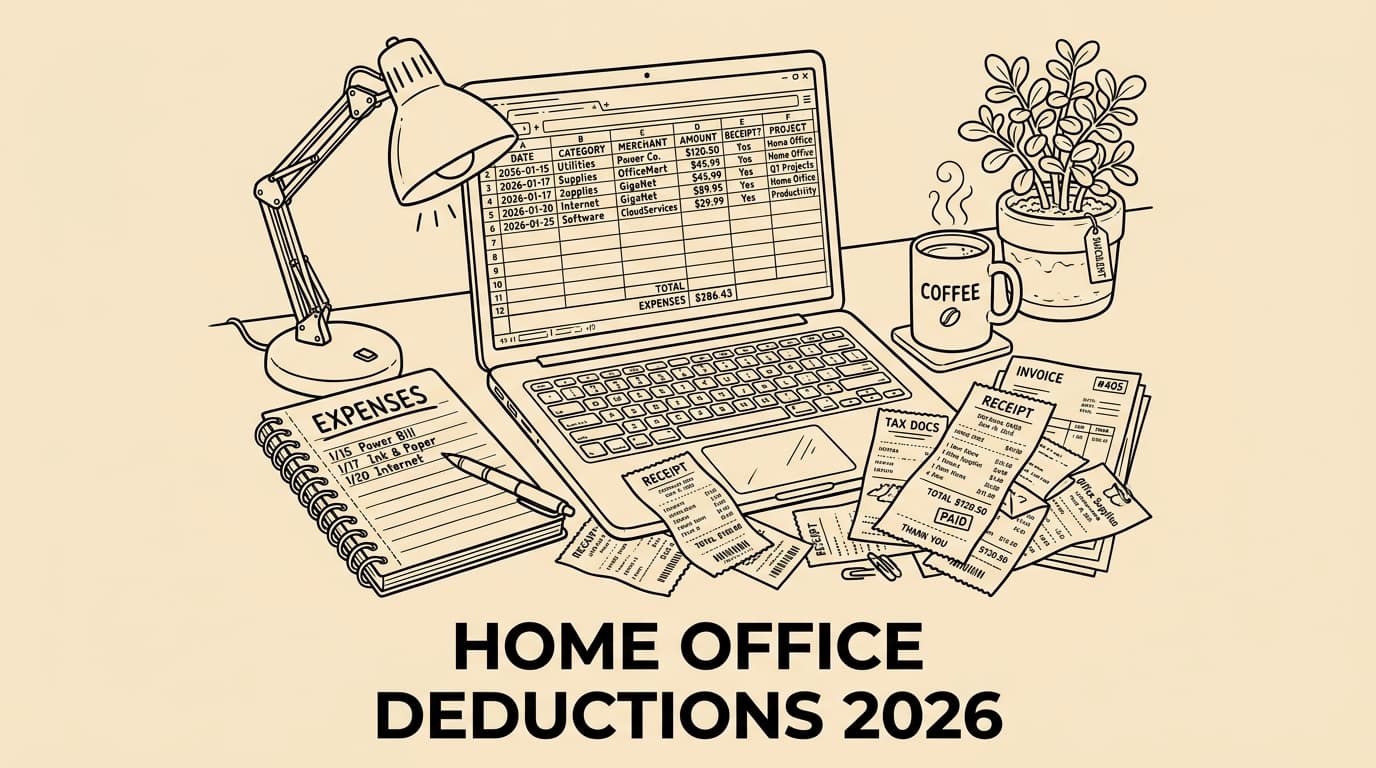
Working from home has become the norm for millions of freelancers and remote workers — and with it comes a valuable opportunity: deducting your home office expenses from your taxable income. Yet many people either miss these deductions entirely or claim them incorrectly, leaving money on the table or creating problems during tax time. This complete guide walks you through everything you need to know about home office expense deductions in 2026.
Who Can Claim a Home Office Deduction?
Whether you can deduct home office expenses depends on your employment status and how you use your workspace:
- Self-employed / freelancers: Most countries allow freelancers to deduct home office costs as a business expense. This is the most straightforward case.
- Remote employees: Rules vary significantly by country. In the US, employees can no longer claim the home office deduction on federal returns (eliminated by the 2017 Tax Cuts and Jobs Act). In the UK, employees can claim HMRC's flat rate allowance. In Germany, the Home-Office-Pauschale applies to employees too.
- Part-time remote workers: You can usually only claim for the days you actually work from home.
The fundamental requirement in almost every jurisdiction is that the space must be used exclusively and regularly for business purposes. A kitchen table where you occasionally open a laptop typically does not qualify — a dedicated room or clearly defined workspace does.
What Counts as a Home Office Expense?
Home office expenses generally fall into two categories: direct and indirect.
Direct Expenses
Direct expenses are costs that apply only to your home office space, not the rest of your home. These are typically 100% deductible:
- Office furniture (desk, chair, shelving) purchased for business use
- Computer equipment, monitors, keyboards, and peripherals
- Office supplies (printer ink, paper, notebooks)
- A dedicated business phone line
- Repairs or improvements made specifically to your office space
Indirect Expenses
Indirect expenses cover the home as a whole. You can deduct the business-use percentage of these:
- Rent or mortgage interest
- Electricity, gas, and heating
- Internet and broadband
- Home insurance
- Cleaning services
- General repairs and maintenance
The deductible portion is usually calculated as: (office square footage ÷ total home square footage) × 100%.
Home Office Deduction Methods
Different countries offer different calculation methods. Here are the most common:
Simplified Method (US)
The IRS allows a simplified method: $5 per square foot of your home office, up to a maximum of 300 square feet — giving you a maximum deduction of $1,500. No depreciation calculation needed, no Form 8829 required. Ideal if your actual expenses are close to this amount or if you want to avoid complex record-keeping.
Regular Method (US)
The regular method requires calculating the percentage of your home used for business and applying it to all eligible home expenses. More paperwork, but potentially a higher deduction if you have significant home costs.
HMRC Flat Rate (UK)
UK taxpayers can claim a flat rate of £6 per week (£312/year) without needing to justify individual costs. For higher actual expenses, you can claim the proportion of costs attributable to your workspace instead.
Home-Office-Pauschale (Germany)
Since 2023, Germany offers a flat allowance of €6 per day you work from home, up to 210 days per year — a maximum of €1,260 annually. No separate room required. For a full home office room that serves as the center of your professional activity, actual costs can be deducted instead.
Step-by-Step: How to Calculate Your Deduction
- Determine your workspace area — measure the square footage (or square meters) of your dedicated home office.
- Calculate the business-use percentage — divide office area by total home area.
- Gather your indirect home costs — annual rent/mortgage interest, utilities, internet, insurance.
- Apply the percentage — multiply each indirect cost by your business-use percentage.
- Add 100% direct costs — office equipment, furniture, supplies.
- Apply any country-specific limits or flat rates if they result in a higher deduction.
Example: Your home is 1,000 sq ft; your office is 100 sq ft (10% business use). Annual home costs: rent €12,000 + electricity €1,200 + internet €600 = €13,800. Deductible: 10% × €13,800 = €1,380. Plus direct costs: new monitor €350, desk €280 = €630. Total deduction: €2,010.
What You Need to Prove Your Deduction
Tax authorities may request documentation. Keep these records for at least 5–7 years:
- Floor plan or sketch showing your office dimensions
- Lease agreement or mortgage statement
- Utility bills and invoices
- Receipts for all equipment and furniture purchases
- Bank statements showing business expenses
- A log of home-office days (especially if using day-based flat rates)
Digital receipts are accepted in most jurisdictions — as long as they are legible and stored securely. Tools like Bill.Dock let you scan and categorize receipts instantly, attach them to expense reports, and retrieve them in seconds during an audit.
Common Mistakes to Avoid
- Claiming a non-exclusive workspace: If your "office" is also a guest room or dining area, most methods require you to show the space is used exclusively for business. Mixed-use spaces may not qualify in the US but may qualify in Germany and the UK.
- Forgetting equipment depreciation: Large purchases (computers, printers) may need to be depreciated over several years rather than deducted fully in year one — depending on your country and the value.
- Missing the phone and internet split: Your phone and internet bill is typically split between personal and business use. Track your business-use percentage.
- Not keeping a day log: For flat-rate methods based on working days (Germany, some other countries), you need a log or calendar showing when you worked from home.
- Missing the deduction deadline: Amending a prior-year return is possible in most countries, but there are time limits.
How Bill.Dock Helps You Maximize Home Office Deductions
Tracking home office expenses manually is tedious and error-prone. Tools like Bill.Dock automate the process: you photograph a receipt, and the app extracts the date, amount, vendor, and category automatically. You can tag expenses as "home office," set recurring cost entries for rent and utilities, and export an itemized expense report at tax time with one click.
This means less time sorting through boxes of paper receipts in March and more confidence that you're claiming every euro (or pound, or dollar) you're entitled to.
Frequently Asked Questions
Can I deduct my home office if I also have a separate business address?
Yes, in most cases. If you regularly and exclusively use part of your home for business — even if you also have a commercial address — the home office deduction can still apply. Document the business activities you perform specifically at home.
Does my home office need to be a separate room?
In the US, the IRS requires exclusive use, which usually means a distinct room. In Germany and the UK, dedicated workspace within a room may qualify for flat-rate allowances even without a fully separate room. Check your country's specific rules.
Can I deduct my entire internet bill?
Only the business-use proportion. If you estimate 60% of your internet is for business, you can deduct 60% of the bill. Be prepared to justify this split if audited.
What happens if I sell my home after claiming the deduction?
In some countries (notably the US under the regular method), claiming home office depreciation can affect the capital gains exclusion when you sell. The simplified method avoids this complication. Consult a tax advisor before deciding which method to use.
Can remote employees in the US deduct home office expenses?
Not on federal returns since 2018. However, some US states still allow employee home office deductions on state taxes. Always check your state's rules in addition to federal guidelines.
Conclusion
Home office expense deductions can represent hundreds — sometimes thousands — of euros, pounds, or dollars in annual tax savings for freelancers and remote workers. The key is knowing what you can claim, keeping clean records, and applying the method that gives you the highest legitimate deduction.
Start by measuring your workspace, gathering last year's home-related invoices, and deciding which calculation method applies to your situation. And consider using an expense tracking tool like Bill.Dock to automate the paperwork — so next year's tax filing takes hours, not days.